Article II · The Campus · Clause 2.2
Collegiate Gothic Was a Choice
When nineteenth-century universities built in stone and pointed arches, they were making an argument about what they were — and who they were for.
- Instrument
- Clause 2.2
- Filed under
- The Campus
- Schedules attached
- 2
- Reading
- 4 min
The Style Was the Message
By the 1880s, American universities faced a legitimacy problem. Many were barely a generation old. Their degrees carried uncertain prestige. Their faculties competed with European institutions that had been awarding doctorates for centuries. Into that anxiety stepped the architect and the building committee, and together they reached, almost unanimously, for the Middle Ages.
The turn toward Gothic Revival and Richardsonian Romanesque on American campuses was not a passive drift of fashion. It was a calculated institutional argument built in stone. When the University of Chicago opened its first quadrangles in the 1890s to designs by Henry Ives Cobb — financed largely by John D. Rockefeller — the trustees had explicitly rejected Romanesque and classical alternatives in favour of English Collegiate Gothic. The recorded rationale in committee correspondence was unambiguous: the style evoked Oxford and Cambridge, and Oxford and Cambridge evoked permanence, learning, and social authority. A new institution, sitting on reclaimed prairie, would borrow a millennium of credibility it had not yet earned.
Princeton's sustained campaign to gothicise its campus tells the same story from the donor side. When the university solicited gifts for Holder Hall, completed in 1910 to designs by Day and Klauder, the fundraising correspondence framed the architecture explicitly as a statement of academic seriousness — a visible commitment to scholarship over mere technical training. Donors were not simply giving money; they were purchasing a claim to an ancient tradition. The style was the ask, and the ask worked.
What the Pointed Arch Displaced
The choice mattered because it was a choice against something. The land-grant universities established under the Morrill Act of 1862 had largely adopted utilitarian brick, Italianate, or Second Empire styles that carried no particular scholarly connotation. Some eastern institutions had done the same: early Yale and Harvard buildings were plain Georgian or Federal, dressed in the straightforward idiom of their colonial founding. Gothic Revival arrived as a deliberate upgrade, a signal that the university was not a trade school or an agricultural college but an institution in the lineage of European intellectual life.
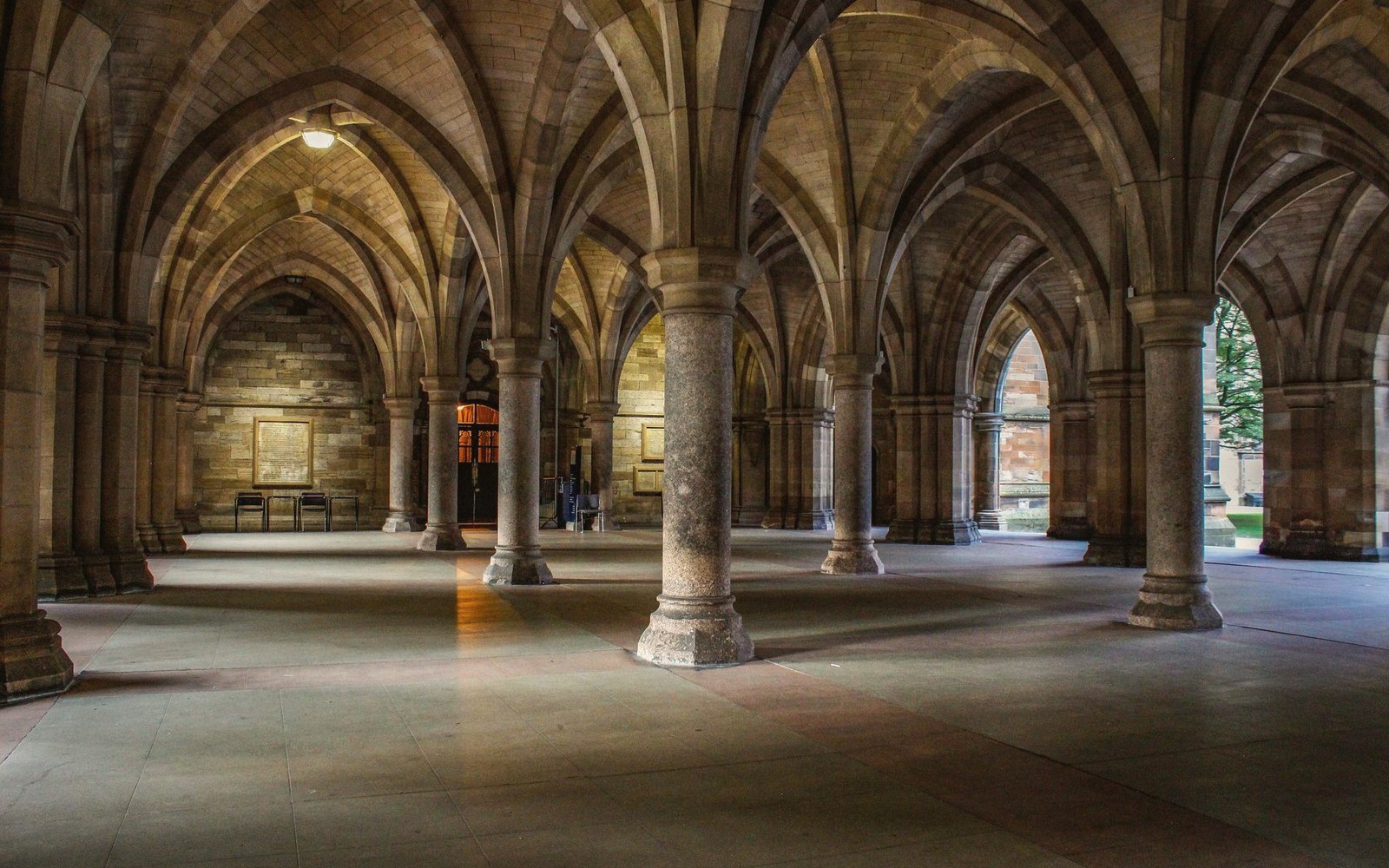
That lineage was, of course, partly fictional. Medieval Oxford had not been built as a unified Gothic composition; it accumulated over centuries. American Collegiate Gothic, by contrast, was applied wholesale, often over a decade or two, to institutions that had no medieval history at all. The pointed arches, tracery windows, and crenellated towers were theatrical — consciously so. Ralph Adams Cram, the most prolific practitioner of the style in the early twentieth century, wrote openly about architecture as moral and institutional argument. When he redesigned Princeton's campus plan from 1907, the aim was not to quote the past but to inhabit it, to make the institution feel as though it had always been there.
The donor correspondence preserved in university archives repeatedly confirms this instrumentalism. Gothic stone was not cheaper than brick. It required skilled masons, imported limestone, and longer construction schedules. Building committees approved those costs not despite the expense but partly because of it. Visible difficulty signalled seriousness. A building that looked as though it cost something, and looked as though it had stood for centuries, told prospective faculty, donors, and students that this institution intended to endure.
The style eventually faded — modernism arrived on campuses in the 1950s with its own institutional arguments — but the logic did not. American universities have never stopped building to signal permanence, ambition, and lineage. The pointed arch was simply one particularly legible version of a claim that the building committee has always been in the business of making.
Also in The Campus
Related clauses